Ισότητα
Δημοσιεύτηκε: Πέμ Μαρ 04, 2021 11:09 pm
Έστω  και
και  δύο φορές παραγωγίσιμες συναρτήσεις. Να δειχθεί ότι:
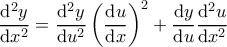
και δύο φορές παραγωγίσιμες συναρτήσεις. Να δειχθεί ότι: και δύο φορές παραγωγίσιμες συναρτήσεις. Να δειχθεί ότι:![\dfrac{\mathrm{d}^2y}{\mathrm{d}x^2}=\dfrac{\mathrm{d}}{\mathrm{d}x}\left(\dfrac{\mathrm{d}y}{\mathrm{d}x}\right)=\dfrac{\mathrm{d}}{\mathrm{d}x}\left(\dfrac{\mathrm{d}y}{\mathrm{d}u}\dfrac{\mathrm{d}u}{\mathrm{d}x}\right)=\left[\dfrac{\mathrm{d}}{\mathrm{d}x}\left(\dfrac{\mathrm{d}y}{\mathrm{d}u}\right)\right]\dfrac{\mathrm{d}u}{\mathrm{d}x}+\left[\dfrac{\mathrm{d}}{\mathrm{d}x}\left(\dfrac{\mathrm{d}u}{\mathrm{d}x}\right)\right]\dfrac{\mathrm{d}y}{\mathrm{d}u}](/forum/ext/geomar/texintegr/latexrender/pictures/8659b28256d4507307008186fac0449d.png "\dfrac{\mathrm{d}^2y}{\mathrm{d}x^2}=\dfrac{\mathrm{d}}{\mathrm{d}x}\left(\dfrac{\mathrm{d}y}{\mathrm{d}x}\right)=\dfrac{\mathrm{d}}{\mathrm{d}x}\left(\dfrac{\mathrm{d}y}{\mathrm{d}u}\dfrac{\mathrm{d}u}{\mathrm{d}x}\right)=\left[\dfrac{\mathrm{d}}{\mathrm{d}x}\left(\dfrac{\mathrm{d}y}{\mathrm{d}u}\right)\right]\dfrac{\mathrm{d}u}{\mathrm{d}x}+\left[\dfrac{\mathrm{d}}{\mathrm{d}x}\left(\dfrac{\mathrm{d}u}{\mathrm{d}x}\right)\right]\dfrac{\mathrm{d}y}{\mathrm{d}u}")
 :
: 
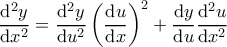
Από κανόνα αλυσίδαςTolaso J Kos έγραψε: Πέμ Μαρ 04, 2021 11:09 pm Έστω
 άρα από τύπο για γινόμενο παραγωγίζοντας τηε προηγούμενη είναι
